Sydenham, Thomsen, HN Italy, RPC and others Coins: Second Punic War, The Denarius 214-195BC


|
 |
Links to Sydenham, Thomsen, HN Italy, RPC etc. Coins: Second Punic War, The Denarius 214-195BC
- Discussion and Pictures of Coins: 214-195BC Second Punic War, Crawford 41-131
- Some observations on postsemilibral bronzes and the date of the denarius
- Updates and corrections to Crawford
- Michael Crawford, notes to the Edinburgh collection.
- Other key references: Kestner-Hannover, HN Italy, RPC1, CMRR, Thomsen ERC, Sydenham
Coins: 214-195BC, Second Punic War, Crawford 41-131
Click on any photo to see that coin. Or click on the right-hand blue link to see the entire set.
214-195BC Cr41/124 Rome 2nd Punic war
Click for SLIDE SHOW of these coins
Click for DETAIL VIEW of these coinswww.flickr.com

214-195BC Cr41/124 Rome 2nd Punic war
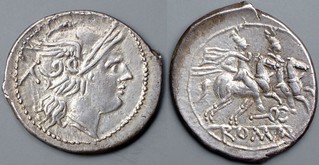
Over the last 200 years a lot of attention has been paid to the date of the first denarius. The relative organisation the first 20 years of denarius coinage is maybe a tougher problem. Many different issues were struck, without named magistrates, with great variations in style, quality of manufacture and weight standards, and involving complex archaeological data. The broad methodological process was established by the Count de Salis, in his organisation of the British Museum cabinet that Grueber then documented. The heavier 1/72 lb denarius issues can be separated from those of 1/84 lb the standard for the next two centuries. The denarius issues can be separated and grouped by the styles of the obverse helmet, as clearly published by Sydenham. Silver can be linked with related bronzes of the same symbols. Evident mint marks can be deduced, L for Luceria, CA for Canusium, KOP for Corcyra, corn-ear for Sicily etc. Recurrent site find locations can isolate some issues, MA and AVR in Sardinia, the incuse Victoriatus in Spain. Presence or absence of issues in hoards serve to arrange the silver issues in time, with guidance from physical characteristics such as weight standard and helmet style. Battle area hoards can help locate issues which appear predominantly in that hoard. Known regional preferences for certain denominations can help locate other issues. The largest group of a consistent style can be assumed to be from the Rome mint. Issues thought to be of anomolous style can be grouped and located to other mints, assisted by the other factors such as mintmarks and find locations. Finally, periods in time are deduced for the entire sequence of issues and the coinage laid out within this timeframe. This is the basic method. Sydenham and Crawford followed de Salis and Grueber in applying the methodology. On this page I discuss comments on Crawford’s arrangements, but I do not propose any alternative for the coins illustrated here. Instead I date each of these sets, for Rome, Sicily and Sardinia, Luceria, and other Italy, to the broad 214-195BC period, and leave dating within this period to your opinion, as reader, guided by various opinions that I cite below the coin sets. The first set, from Rome, using the methodology I describe, includes those regular style issues which all the other evidence fails to place anywhere else. It includes the following Crawford issues: 41, 44, 50, 51, 52, 53, 56, 57, 58, 112, 113, 114, 115, 116, 117, 118, 119, 120, 121, 122, 123, 124, of which the 112 through 124 issues are likely later.
214-195BC Cr42/96 Sicily Sardinia 2nd Punic war
Click for SLIDE SHOW of these coins
Click for DETAIL VIEW of these coinswww.flickr.com
214-195BC Cr42/80 Sicily Sardinia 2nd Punic war
There are a limited number of coin issues from Sardinia, identified by the prevelance of site finds having the mintarks C, AVR and MA, with possibly some anonymous silver too. These three bronze issues are helpful in understanding other Punic war coinage. Military circumstances places these coins in the 211-209BC period yet they were produced to a variable quality and certainly not of sextantal weight. This has bearing on how we view issues from Sicily and other Italian mints. The coins of Sicily are predominant in their use of the corn-ear as symbols. Many issues use it and these can in turn be linked to other issues using the methodological process I described for the Rome set. Thus we get a set from these two large islands, the first overseas provinces of Rome. This is accompanied by a lone Spanish issue, the Crawford 96 victoriatus with incuse legend, a type mainly found in Spain and of heavy weight that is presumed to have been struck by Publius or Cnaeus Scipio, the father and uncle of Scipio Africanus, before their defeat by the Carthaginians in 211BC. This set includes the following Crawford issues: 42, 67, 68, 69, 70, 71, 72, 73, 74, 75, 76, 77, 78, 79, 80, 81, 82.
214-195BC Cr43/99 Luceria and Canusium 2nd Punic war
Click for SLIDE SHOW of these coins
Click for DETAIL VIEW of these coinswww.flickr.com
214-195BC Cr43/99 Luceria 2nd Punic war
The coinage of Luceria and Canusium in the Apulia region, the heel of Italy, deserves a specialist publication just on its own. A glance in HNI shows a continuous production of bronzes from about 275BC that continues until the post-semilibral period. Coinage of Roman type with the mintmark L or P was started about the same time, perhaps 215BC, and continues throughout the early denarius period to the early 2nd century BC. Reasonably large volumes were produced in aggregate although many individual issues are rare. The coinage includes the Italian dextans and quincunx denominations, and is, on the whole, anomolous in style, with several cases of denominations that do not follow the standard prow types. There seems to be four, five or six distinct phases of the main coinage with mintmark L, with different weight standards and identifiable styles. Silver was struck too, although only the fractions, and there is a related bronze issue with mintmark P that has clear stylistic links with the L issues. Coins with the mintmark CA are also clearly linked to these issues although probably struck in a separate mint at Canusium. Crawford lists nearly 100 types or varieties but a review of the coin material available to me, from personal inspection, in books and on the internet, suggest there may be missing types, but also a number of separately numbered types that are in fact the same issue, and perhaps one type that does not belong to Luceria at all. A huge dilemma with the Luceria issue is that many of these types are very rare and very difficult to distinguish from each other and Crawford’s catalogue only illustrates 30 of them. Because the basis for categorisation is not fully described in Crawford, one is sometimes faced with problems of a coin that matches type A for style, type B for weight, and type C for design type. This is a perfect example as to why I love Roman Republican numismatics. There is so much that can be discovered by inspection of available coin material, and it will become increasingly easier as more coin images become available on the internet. This set includes the following Crawford issues, sorted to the best of my abilities: 43, 97, 98, 99, 100. I have also a collection with many more types having the L or P mintmark, but not on public view as it contains copyright photos; anyone with a specialist interest in these Apulian bronzes should contact me to request a pass-key.
214-195BC Cr45/131 Italy 2nd Punic war
Click for SLIDE SHOW of these coins
www.flickr.com
|
Click for DETAIL VIEW of these coins
The remaining coins are the most difficult to classify, having neither the continuing story of the Rome mint issues, nor the clear mintmarks of the island coins or of Luceria, nor the clear design features of Etruria. Mintmarks, stylistic groupings and location evidence from hoards and site finds are used to classify these as from other Italian mints. For examples, Crawfords 59 to 62, apex and hammer, caduceus, victory, and early rostrum tridens, are assigned to a non-Rome mint based on their stylistic links and difference from the, assumed, Rome issues. We might be all entirely wrong but in that case, we should maybe blame Count de Salis, because his arrangement of the London cabinet led to some of the later decisions of Grueber, Sydenham and Crawford to set the same direction. Some other decisions are a little easier, site and hoard finds in Apulia tell a story, and others have suggestive mintmarks such as retrograde N for Nola. Most oddly, the issue with the mintmark ROMA, Crawford 84, is assigned to a non-Roman mint. This set includes the following Crawford issues: 45, 46, 47, 48, 54, 55, 59, 60, 61, 62, 83, 84, 85, 86, 87, 88, 89, 90, 91, 92, 93, 94, 95, 101, 102, 103, 104, 108, 109, 110, 111, 125, 126, 127, 128, 129, 130, 131, with the later groupings likely also later in date.
210-200BC Cr105/107 Etruria 2nd Punic war
Click for SLIDE SHOW of these coins
www.flickr.com
|

Click for DETAIL VIEW of these coins
The coins come from Etruria and are early bronzes (probably 210 - 200 BC). They all have absolutely characteristic obverse styles with very large upward staring eyes that I term bug-eyed, and pronounced lined hair. Within the series however there are four clear different designs. (1). With two sailors on the left deck of the prow, and with the staff protruding the left of a from a flat-topped deckhouse. These coins generally have cupped flans, convex on obverse and concave on reverse, that seem to suggest a unique manufacturing technique not seen on other RR coins. (2). The regular Crawford 106 staff series, with staff above the prow. These coins always have a triangular shaped forward-deckhouse just next to the acrostilium (prow-stem) with a club within it, presumably a weapons store on the actual ships. (3). As (2) but with the staff is running through a square-topped deckhouse that is on top of the triangular deckhouse with club that I described in (2). (4). As (2) but with a club also on the obverse, the rarest type of the series. This Etruscan series is almost as varied and interesting as the Luceria bronze (L, P, LP, CA) series but almost totally unknown.
Click here for the next set of coins
Some observations on Postsemilibral bronzes and the date of the Denarius
Despite the neutral view I have taken in assigning dates to the above four sets of coins, I do of course have views on the period. Just as an example I would like to share my thought processes on one of many numismatic dilemmas in the Republican era. The postsemilibral bronzes, Crawfords 41, 42 and 43 from Rome, Sicily and Luceria respectively, have a quite unclear relationship with the quadrigatus, the denarius, and the so called post reform bronzes. I set out here some unformed thoughts which may provoke a response from readers, starting with an outline of my suggestions.
- Each of Crawford 41 from Rome, 42 from Sicily, 43(part) from Luceria, 59 Apex and Hammer, 60 Caduceus, 97(part) from Luceria, and possible other series with heavy bronzes such as 76 Branch, appear to be based on an As weight distinctly higher than sextantal although not greatly higher. Since several of these are definitely associated with silver denarii, the existing pre/post denarius divide based on postsemilibral/sextantal bronze weights should be reexamined. It is worth considering whether the denarius was introduced coincident with these heavier-than-sextantal bronzes, and that some heavier bronzes with symbols, as well as their related silver, were struck coincident with Crawford 41.
-
The classic Crawford 56 type may never have been struck to sextantal standard but likely on a one and
a half ounce standard and thus probably commenced later than the denarius introduction date.
Crawford 56 as described and illustrated by Crawford
includes coins that seem to belong to other issues. Once these are removed, specially the struck Crawford 41 As reported by Russo, what
remains seems to include no coins struck to a sextantal standard. Indeed it is debatable whether sextantal was ever used as a
weight standard as some bronze issues were distinctly heavier than sextantal, and others were struck at one and a half ounce.
- The archaeological and other numismatic evidence collated by Santini, Thomsen, Buttrey and Crawford does not argue against a 214BC date for the introduction of the denarius, coincident with Crawford 41 and the heavier bronzes listed in 1 above. I suggest perhaps a neat solution. Crawford 41,42, some of Crawford 43 and 97, the heaviest bronzes with symbols and their related heavy 4.5 gram denarii were possibly all introduced around the same time in 214BC, with Crawford 56, the lighter denarius and associated bronzes some years later.
The long held views, based on strong evidence, that all these coins as well as related silver were introduced in the 215-210BC period, remains intact, but some rearrangement within this period seems to make sense, so as to fit better with the evidence than some of Crawfords assumptions. The reconsideration of the Crawford 41 aes by Roberto Russo in essays Hersh prompts a fresh look at what remains from Crawford 56. A significant body of new evidence on the anonymous and Luceria bronzes series, from several collections published in the 1990s and 2000s, should be a great opportunity to do more work on this. These suggestions are not yet properly tested, and I have frankly not yet searched for contrary evidence, but I hope it will be thought fodder for those interested in the early denarius and related bronze.
The path starts with many apparent inconsistencies within the confirmed view as outlined in Crawford.
Roberto Russo in Essays Hersh proves conclusively that there is an As in the Crawford 41 series, with characteristics easily enough confirmed from style and die links. He lists examples at 66.6, 62.0, 57.1, 56.1, 53.0 grams. Here is another example at 45.5 grams that is clearly linked to the Essays Hersh illustrated specimens, an obverse die link with Russo's coin 7 and a possible reverse die link with coin 6:

Now that the type is known, other specimens appear more often, indeed it appears the As may be commoner that the previously recorded Semis, with which it is clearly linked in style, and may appear in other lighter weight examples such as the above illustrated. I concur with Russo that this is of a different and earlier issue than the classic Crawford 56 As, for which the following is a model example, at 38.4 grams:
However where I diverge is in accepting that other so called post reform coinages coincide with this Crawford 56 rather than the earlier Crawford 41 type. The following 60 gram caduceus As is quite typical of the series, indeed the average of the series is quoted by Crawford as 53 grams which undoubtedly includes many worn specimens, so the mark weight is clearly higher. Santini lists 6 examples above 54 grams, the nominal sextantal weight. Likewise with Crawford 59 apex and hammer I recently saw a very worn specimen at 59 grams that was probably 65 grams at striking. It does not appear that these coins were struck at a standard that is lower than that of Russo's 41 As, and including for mint losses and wear that standard is at least 2 ounces. I doubt this series was struck at the same standard as Crawford 56, it is higher.

Coming back again to Crawford 56, Crawford states the weight standard is based on an As of about 54 grams and gradually declines to a level at which Crawford 50 and 57 are struck. Which he states as 40.5 grams and 45 grams. Russo lists his Crawford 56 Asses at 40.5, 38.5, 36.6, 26.8, 26.6, 19.6 grams to which my illustrated 38.4 gram example can be added. In Vecchi sale 3, there are illustrated classic style Crawford 56 Asses at 33.6, 45.6, 42.2, 36.4, 37.9, 34.2, and a worn example in the style of Russo's 41 As at 50.6 grams. Additionally Vecchi sale 3 illustrates an anomolous long necked As, with a triangular boat house in the reverse that is untypical for the series, at 48.5 grams, but that matches Crawford plate XI coin 6. Let us set this aside, it is likely a separate issue possibly associated with some symbol type. Of the other coins illustrated by Crawford, plate XII coin 4 is the classic Crawford 56/2; plate XI coin 7 is actually a Crawford 106 type without symbol, compare plate XX coin 15; and plate XI coin 4 is Russo's 41 As. Crawford only illustrates four Asses but if a larger body of evidence is considered then it becomes easier to separate the classic Crawford 56 from other anonymous series. Crawford's classification thus crumbles in sand. Two of his illustrated coins are from other series, one is indeed anomolous. Taking these out, and considering the weight evidence that I see, I expect that the classic Crawford 56 was never struck at two ounces but at a 35 to 45 gram standard or thereabouts, possibly a 1.5 ounce standard ie 40.5 grams. Anyway it was never sextantal. The Crawford 56 Dupondius was probably overstruck on a Crawford 41 As. Whereas certain other post reform series and Crawford 41 were indeed struck at a higher standard, at least initially. No one would deliberately strike at a 60 gram standard when a 40 gram standard appears to suffice for the main coinage. Not a chance. What might the standards have been? This requires a lot more study. I am not proposing this but a proper metrological and style study that separates supposed Crawford 41 and 56 into its elements might better confirm the arrangement. Someone with a keen eye and many catalogues could contribute a lot here.
Now, coming back to Crawford 41. Let us look at the fractions. They typically indicate an As weight of about 50-75 grams which is consistent also with the heavier post reform asses, but one rarely sees examples of the supposed post-semilibral weight of 3-4 ounces ie 80-100 grams, the triental or quadrantal of traditional Republican numismatics. Furthermore, small change purses from the early Republic are consistent in including postsemilibral pieces. These would have exited the small change purse if they were considered to be worth more in bronze. Yet the Crawford 41 pieces clearly circulated for decades from their state of wear.
Let us briefly consider Crawford 43 and 97. Well I do not intend to consider them in any depth except to note the obvious which is that the series is totally confusing. Crawford 43 apparently misses a Quadrans yet includes a Triens similar to that illustrated below. Crawford's Triens, plate VIII coin 11, firstly is misdescribed as it likely has an L before the prow as illustrated below, and secondly matches in style and fabric the illustrated Crawford 97/5b Quadrans on plate XVIII but does not match the Triens illustrated as Kestner-Hannover 279. If we take the below illustrated Triens to be Crawford 97/4, as compared with the clearly different Crawford 43 Triens which matches KH279 and is illustrated in the same set, then this Triens is a clear example of a so called post reform coin being based on an As weight of 69 grams, much heavier than sextantal.
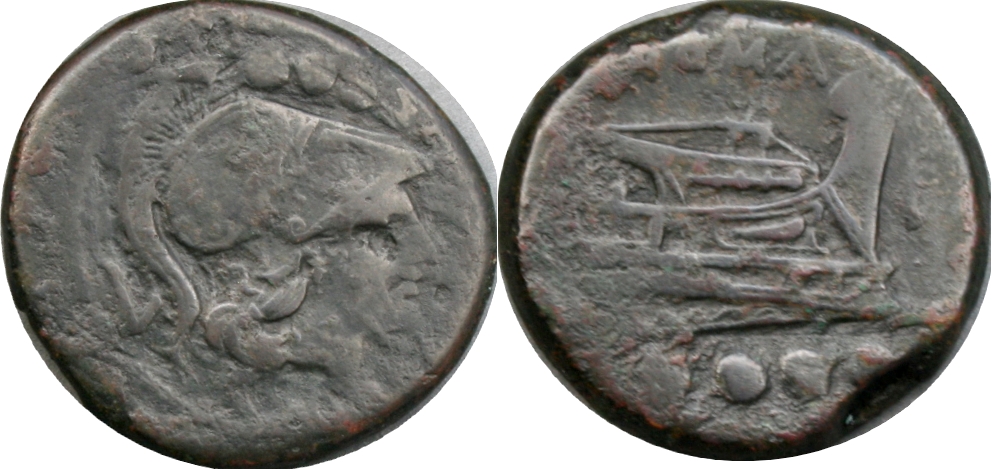
Other coins show the same pattern. The common Crawford 97/6 triens is often found at 10-11 grams. Clearly there are heavier examples from Crawford 43, but the point remains that 10-11 grams is not sextantal, no mint master given a pound of bronze will strike 30 sextantes when he could choose to strike 36 for the government and a few more on the side for his wine and bread at lunchtime, and specially not if the mint at Rome was making 48 or more Cr56 sextantes from the same pound of bronze. Indeed Crawford says 64 grams is the average weight of early Crawford 97. How could this be sextantal? It fits better if all these coins were coincident with Crawford 41, 59, 60 and other heavier-than-sextantal bronze issues. However I do recognise that a few very early Luceria issues were distinctly heavier based on a 90 gram As and should probably not be associated with the early denarius but earlier. I could explore further and there are many other examples of inconsistency in the dreadfully complex Luceria series, but I wished only to again demonstrate that the neat separation between sextantal and post semilibral is not really there, rather that some series were struck at a higher standard than sextantal, apparently into the denarius period, and others were struck at a distinctly lower than sextantal standard.
Thomsen quotes Santini's views on the bronze standard at the introduction of the denarius. Santini says that heavy symbol denarii weighing 4.53 to 4.32 grams with no accompanying bronzes in the same series, must be of an earlier date that the symbol denarii with an average weight of 4.13 to 3.98 grams being accompanied by fully sextantal bronzes. Santini concludes that the heavy denarii are associated with post semilibral bronzes and the lighter coins with the 40 gram asses. Thomsen however does not agree that clear parallels can be drawn, that the series cannot be neatly allocated, heavy silver to heavy bronze, and light silver to light bronze. The matches are not there in every case and Thomsen quotes for example the heavy caduceus and apex hammer denarius which are combined with so called sextantal aes.
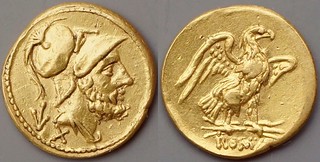
New evidence however comes from the light thrown by Russo's 41 As, as well as from the confusion of Luceria pieces, with many overweight examples from the Crawford 97 series. This suggests to me that Crawford 41 and 43 and the initial heaviest symbol bronzes (which may later have fallen in weight) were likely initially struck at more or less the same standard, and that standard was either slightly more than sextantal (maybe 16 asses in 3 lbs) or in some cases full sextantal with the coins exiting the mint averaging 54 grams per As. I suggest that Santini was more right than wrong and that this standard coincides with the 4.5 grams denarius. Where Thomsen was right is that the 4.5 gram caduceus denarius is indeed associated with the caduceus bronzes. What perhaps neither man considered, is that the caduceus bronze may have been coincident with the Crawford 41 bronzes. Or that the Crawford 56 anonymous sextantal As does not in fact exist, but a 1.5 ounce standard Crawford 56 As does, as does a heavier Crawford 41 As. I would like the reader to consider whether all struck bronzes from Crawford 41 onwards are in fact associated with the denarius system. It is a potentially neat solution to a difficult problem studied over centuries, and probably wrong as such but it is worth thinking over. An additional fact to bring into the mix is the apparent overvaluation of silver, indicated by the gold 20, 40 and 60 Asses. If the earliest denarius was also associated with heavier bronzes, this would be quite consistent with a high value for silver. It reverses the argument that the growth of the denarius coinage coincides with the import of large volumes of silver from Spain after 210BC and is consistent with the debased Quadrigatus. Silver was scarce after Cannae and its overvaluation against both gold and bronze is to be expected.
Finally we come to dating. Thomsen concludes that the Crawford 41 and later bronzes must date from just after 215BC based on parallels with the coins of Italian cities involved in the second Punic war. He concludes that the denarius system pre dates 211BC based on Sicilian hoards again based on second Punic war movements. Buttrey, summarised in Hoards and Archaeology concludes that the denarius dates from the 214-211 BC period. Marchetti suggests that the earlier rather than later date is more plausible as one would expect the Roman coins found in Morgantina to date from the Roman occupation before 214 and not from the Punic occupation 214-211BC. I do not here wish to get into these arguments in depth, but just to note that my simple suggestion that all Crawford 41,42,43 bronzes be associated with the first denarius would be quite consistent with a 214BC date for the commencement of the denarius system. It also further relieves the absurd dating squeeze on the myriad early denarius issues as described by Hersh in NC1977. Why the system was introduced remains a mystery. Perhaps Fabius Cunctator needed to keep himself busy whilst waiting for Hannibal and decided to reform the coinage.
Books: Other Key References
Updates and Corrections to Crawford
Refer to the main text on RRC above for an overview of the areas of the dispute. The following essays document some of the definitive updates and corrections. Most of the corrections address minor shifts in dating within a period, or the discovery of new sub-types to existing series. Incremental updates are by nature a continuous process and we should expect to see such essays appear from time to time in the future.
NC1977: Charles Hersh, Chronology and Interpretation of the Roman Republican Coinage. Numismatic Chronicle 1977
Essays Hersh: Coins of Macedonia and Rome: Essays in Honour of Charles Hersh. London 1998
From Coins to History: Selected Numismatic Studies, Harold B Mattingly, 2004
The Mesagne Hoard Charles Hersh and Alan Walker, ANS Museum Notes 1984
Charles Hersh reviewed RRC in the 1977 Numismatic Chronicle - Hersh's views essentially form a first revision to RRC. The most significant update is the rearrangement of the earliest denarii classified by Crawford in the 211-207 BC period, into a somewhat longer timescale. The large Cr53 issue and related coins with peaked, rather than splayed or curved visors, are moved into a later period - the latter part of the 200's BC decade - as they are missing from all early hoards. He also provides a rearrangement of the coins in the second half of the second century BC, Crawford's series 219 through 271, but this superseded by HB Mattingly's later update. In the same NC1977 article, Hersh provides individual comments on about 60 further individual issues. In his essay 'Sydenham in Retrospect' published in "Essays Baldwin: Mints Dies and Currency, 1971", Charles Hersh also comments on about 50 coins in Sydenham's catalogue. As this was published at the same time as Crawford they did not make it into that catalogue and can thus be considered updates.
Essays Hersh, 1998, is an update to Crawford on many aspects of Roman Republican research, sufficiently comprehensive
to include it in the "catalogue" listings in this website. The most important essay, by Roberto Russo,
is a significant additional corpus of bronzes not listed in Crawford, in many cases completing series that missed only
one or two denominations. An updated list of RR bronzes including Russo"s additions is on:
Roman Republic Bronze Rarities.
Contents of Essays Hersh (some discussed elsewhere on this website) include
- Selinus and the quadrigatus, by Michael Crawford;
- The Mars/eagle and thunderbolt gold and Ptolemaic involvement in the Second Punic War, by A.R. Meadows;
- More evidence for the early denarius, by Richard Schaefer;
- Some late 'early' Republican quinarii, by Richard Witschonke;
- Unpublished Roman Republican bronze coins, by R. Russo;
- Roman Republican coinage c.150-90 B.C., by H. B. Mattingly;
- The coinage of the Social War, by Andrew Burnett;
- Coinage, credit and the aerarium in the 80's BC, by J.H.C. Williams;
- The coinage of Bibulus again, by Michel Amandry;
- A group of Eraviscan denarii, by Robert Freeman;
- Roman Republican coins in the Manchester Museum, by Keith Sugden;
- Overstrikes and imitative conages in central Italy in the late Republic, by C. Stannard.
HB Mattingly, in From Coins to History, consolidates various studies previously available in scattered sources. Most importantly for the Roman Republic are the studies on the dating of the denarius of the late second and early first centuries BC. HB Mattingly's dating for the late second century BC is widely accepted. For the mid first century BC, Hersh and Walker provide a slightly different chronology than HB Mattingly based on analysis of the same key hoard ("Mesagne"). Harlan (see Coins and History on this site) has again a different dating but his deductions are rather speculative in some cases and not fully in line with the hoard evidence. As the latest studies, HB Mattingly's should be considered definitive on most of the 150-50BC period, with Hersh and Walker for the 75-58BC period that HB Mattingly hardly comments on.
Octavian's Imp Caesar and Caesar Divi F series are now considered to be from the Imperatorial period, and Sutherlands dating in RIC1 is now usually accepted. However if you have a copy of HCRI you don't need RIC1.
A Catalogue of the Roman Republican Coins in the collection of the Royal Scottish Museum Edinburgh, Michael Crawford, 1984
Highly important, not because of the coins, but because it was written by Michael Crawford and he
took the opportunity to comment on updated typology research since the
publication of RRC in 1974. It is a rare book, so, in combination with the Surveys of Numismatic Research written
by Michael Crawford, I've reproduced the text of the main comments in their entirety on
Michael Crawford's Surveys of Numismatic Research page.
Other Key Reference Books
Kestner-Hannover: F. Berger, Die Münzen der Römischen Republik im Kestner-Museum Hannover (Hannover, 1989).
4000 coins illustrated, mostly rare bronzes that are not to be found in any other published source (perhaps with the exception of the Goodman collection). High quality photos on the page facing their description therefore very easy to use. Catalogued according to Crawford, it is an important illustrated companion when referring to bronzes. A significant number of later bronzes in the collection are classified as unattributed local types – falling outside the stylistic boundaries of Crawford's RRC, which highlights an important area for future study. The layout of the plates allows you to understand stylistic matches and differences better than any other catalogue. Quite difficult to find although not really "rare" as books go - several examples come up for sale each year. It's worth a significant premium to acquire.
HN Italy: Historia Numorum - Italy, NK Rutter, British Museum 2001
Important for the dating of early Roman coinage, and fundamental for understanding the coins of the Italian communities after the Roman conquest. It places the early didrachm and aes grave coinage of Rome in an Italian context and updates Crawford's dating for this period based on Burnett’s more recent studies, though the dating assumptions remain contentious. The bronzes of Brundisium, Paestum, Cosa and other Italian communities are early provincial coins so HNI can be seen as the predecessor of RPC for Italy - any collection of RR bronzes should include some representative examples. Many still-quoted books on Greek or Italian coinage include long-discredited dating based on a 269BC introduction of the denarius and associated Italian bronze coinages, and HNI is a badly need update to their dating. Also useful for Social War coinage. 42 good plates, illustrating a large sample of types - SNG France 6 is a useful source of pictures for types not illustrated.
RPC1: Burnett, Amandry, Ripollès, Roman Provincial Coinage I. From the death of Caesar to the death of Vitellius, British Museum Press, 2 vols, 1992
A fundamental reference, it covers many coins of the Imperatorial period (Sear's HCRI provides a complete list of RPC entries for the Imperatorial period), accurate and up to date analysis in many cases building on earlier work by Grant in FITA: see my comments. Excellent plates in a separate volume. Due to its encyclopaedic coverage its can be difficult to get an overview: there is a very interesting 68 page introductory section that comments on authorities, production and circulation, denominations and types but it presumes some familiarity with provincial coinage. The analysis is critical and thorough and the authors do not hesitate to place coins in the "uncertain" category - there's not much speculation. A small and inessential supplement volume was published in 1998, mostly consisting of varieties to types already in the main volume. Prices for RPC1 spiked to very high levels once out of print, but after being reprinted in 2006 it's now readily available and excellent value. Essential.
CMRR: Coinage & Money Under the Roman Republic: Italy and the Mediterranean Economy, Michael Crawford, 1985
Provides valuable context to the Roman Republican coinage. If you are interested in provincial issues during the entire Republic (and not just from 49BC onwards), or in the parallel developments in Roman coinage and that of its neighbours from 200BC onwards, then this is essential reading. Its scope is Roman coinage as well as provincial and local coinage in the early Roman provinces, dependencies, allies and trade partners. The book takes a sweep around the Mediterranean, first dealing with the early coins of Italy and Rome. then the provinces as they are established, with intervening chapters on developments in Roman coinage, so you gradually build up a picture of the development of coinage under Roman rule. It is a much more stimulating read than Crawford’s RRC. Many illustrations in the text, though not of the highest quality.
Thomsen ERC: Rudi Thomsen, Early Roman Coinage (3 volumes, Copenhagen, 1957-1961).
Fundamental research on early Roman coinage on which all later books rely. It lays out exhaustive and scientific proofs for the dating of coinage pre 200 BC, which still hold good except for corrections that have resulted from more recent hoard evidence. It is a book you need only read once for clarity on the 1960s dating revolution - then all the references in Crawford to "see Thomsen ERC" will make sense. But having read it once you will probably want to read again for the pleasure of its illuminating text and copious high quality illustrations. As well as addressing dating, it contains a lot of material evidencing mint-locations in the 2nd Punic war, which greatly enhances collecting interest for this period. It also has useful contextual discussions on the local Italian currencies. Volume 1, which is often available on its own, surveys the numismatic evidence, with extensive photos of both Roman and related local Italian issues, and has an excellent survey of prior numismatic research. Very interesting in its own right. Volumes 2 and 3 address respectively the date of the introduction of the denarius, and pre-denarius coinage, which seems an odd order, however understanding the date of the denarius is the essential pre-cursor to any discussion of the pre-denarius coinage.
Sydenham: E. A. Sydenham et al., Coinage of the Roman Republic (London, 1952).
An attractive single volume handbook on Roman Republican coins, although dating for earlier coins has been superseded, it remains useful and widely referenced. Easier to use than Crawford because its column layout allows you to scan the listings more quickly and it has a more intuitive numbering system. The division of the coinage into coherent series with common styles or issuers allows you to easily grasp the outline of the coinage, and all the information on a given coin or series is presented in the one place, whereas in Crawford you have to hop between the catalogue and the explanatory text. However as it is less often cited in recent years due to the easy availability of HCRI and RCV Volume 1, and recognising its outdated dating, I've demoted it from "essential" to "useful". The analysis and relative chronology of the helmet-styles of the early denarius remains valid today (although the absolute chronology is incorrect). Logical and inclusive coverage of Imperatorial coins, close to Sear's HCRI. Also useful for Social War coinage which is omitted from Crawford. Sydenham's rarity estimates are still the standard, although I've published updated rarities for struck bronzes elsewhere on this website. Excellent plates in the original, terrible reduced-size plates in the Durst reprint, which should be avoided. On the downside, the dating is clearly incorrect for pre-150BC coins, the rationale for assigning mints to Italy or Rome has not withstood the test of recent hoard evidence, far fewer coins are illustrated than Crawford - almost no bronzes - and you have to take a lot of the chronological analysis on trust, it is not explained in the book. If you can also find the following, although a commentary on Sydenham it contains a lot of discussion material that is missing from Crawford:
Useful
Sydenham in retrospect: Charles Hersh, in Essays in Memory of Albery Baldwin, 1971
Subtitled: Revisions, Corrections, and Some Rare and Unpublished Additions to that Author’s "The Coinage of the Roman Republic". 50 issues are discussed over 25 pages and there are five good plates of the material discussed, all silver. A cross-check indicates that the amendments have been reflected in Crawford RRC, but not the interesting discussion by Hersh much of which relates to the discovery process for the new varieties.
Haeberlin: E. J. Haeberlin, Aes Grave. Das Schwergeld Roms und Mittelitaliens (Frankfurt, 1910).
Two volumes with text and plates. The plates volume, in a massive large folio format, has high-quality illustrations of thousands of genuine Aes Grave (Haeberlin included all the Aes Grave he could find) with accurate weights. I use it for (a) a guide for identifying genuine aes grave: style, manufacturing technique and metrology (b) visual indication of frequency / rarity of various examples (c) weight ranges, uniquely helpful in considering the libral-sextantal reductions from 225-212BC. When using Haeberlin as a test for genuine Aes Grave, bear in mind that forgers probably will not have a copy to hand. So when you see 10 coins side by side in Haeberlin, all having similar flan-morphology features e.g. casting sprues, recessed borders or whatever, as well as relief-morphology, device styles and surfaces, then you have a set of fingerprints which you can check against your coin. Originals are very expensive ($3000+) - a facsimile edition has been reprinted by Forni. It has the plates separate, loose in a box and is good enough quality for a normal student, given the plates are full size which is very large indeed. Available Forni reprints can be found at http://www.fornieditore.com
SNG BM Spain: SNG British Museum Spain, PB Purefoy, A Meadows, British Museum 2001
Important for the provincial coinage of Spain during the Republic, struck on Roman standard and paid to Roman legionaries in lieu of regular Roman coins. Copiously illustrated. It should replace Burgos' catalogue as the standard reference for the series. Read with Knapp, R.C., The date and purpose of the Iberian denarii, NC 1977.
FITA: M. Grant, From Imperium to Auctoritas Cambridge, 1946
Covers imperatorial issues from Julius Caesar to Augustus. Superseded by RPC, but interesting as it group coins by type of issuer (e.g. local magistrates, imperators) and discusses each coin as an essay within its historical context. Still useful if bought as an addendum to RPC, which has many references to FITA. Particularly in cases where there has been no further research since FITA, RPC1 leans on FITA for background information. The 1946 edition is fairly difficult to find, but is not especially rare. The 1969 reprint is widely available but has poor-quality reduced-size plates, however if you already own RPC1 and want FITA for the narratives then the lack of plates is not such a drawback. Grant's deductions are said to be not always watertight and indeed some of the historical deductions seem rather speculative, but in case of later updates you can always refer to RPC. FITA contains a wealth of detail and it has a similar relation to RPC as Grueber has to Crawford, i.e. the authors of RPC assume you have FITA to hand and do not repeat. My own copy of FITA was previously owned by Professor Alföldi, the author of Caesar in 44 v. Chr. and has his sporadic annotations and corrections.
Less Useful, or difficult to find
RIC1: Roman Imperial Coinage Vol.1 31BC-AD69, CHV Sutherland, London 1984
Catalogues the Caesar Divi F and Imp Caesar coins of the last five years of the Republic (32-27BC), inexplicably omitted from Crawford. The general introduction and discussion of dates and mints for these coins is of interest but RIC1 is otherwise quite light on text, referring for its numismatic evidence to Sutherland's "Octavian's Gold and Silver Coinage from c.32 to 27BC" (Quaderni Ticinesi 1976, offprint republished 1997). However assuming you already own Sear HCRI, an essential volume in your library, then RIC1 adds no extra information and is not essential.
CNR: Corpus Nummorum Romanorum Monetazione Republicana, A. Banti, 9 Vols Firenze. 1982; and Corpus Numorum Romanorum Vols 1-6, Banti, Simonetti, Firenze 1972-74
Photographic corpus of RR coins, principally silver, taken from auction catalogues, museum and private collections, arranged by family name. Italian with English translations. The first six volumes of the CNR Roman Imperial set (out of 18 volumes in total) cover the Imperatorial and Augustan period, with the same approach as the CNR Roman Republic set. CNR is rather strong on very rare coins not seen in many auctions, e.g. it has got multiple examples of Brutus' EID MAR and multiple illustrations of types with complex varieties or symbols, therefore it is still quite valuable even in the age of online databases such as WildWinds. It is also useful for establishing the auction provenance of rare coins as it lists the source of every photo. However the quality of the photos is often very low depending on the original source and I therefore considered it less useful than web-based alternatives. Unfortunately in July 2009 CoinArchives removed most of its database from public access as a reference source. If that trend continues then there may still be a role for book format databases.
d'Ailly: Recherches sur la Monnaie Romaine Depuis son Origine Jusqu a la Mort d'Auguste, Baron d'Ailly, Lyons 1864-69, 4 vols, 1100 pages, 114 plates, Forni reprint
In the absence of a catalogue of the massive Paris collection this is as good as you can get. 4 volumes, excellent and generally stylistically accurate line illustrations, particularly of bronzes which may not be found elsewhere, though I have been told that in some instances rare but worn coins have been erroneously completed in the illustration which makes the plates less reliable than they should be. Much of the analysis (French) is still worth reading 140 years after publication, it forms building blocks to 20th century research on bronzes. The Forni reprint is perfectly adequate for a line-drawing-illustrated book although some plates are rather washed out. It is still rather useful as any odd or scrappy bronzes have me diving for d'Ailly, but Kestner-Hannover with its photos of Bahrfeldts bronzes must take precedence over d'Ailly with its line drawings of an equally great collection. Volumes 1 and 2 of this book are available for free download from Google books.
Babelon: E. Babelon, Description historique et chronologique de monnaies de la république romaine (Paris, 1885).
The handbook on which the "family name" organisation and numbering of Roman Republican coins is based. French. Except for the prow series it does not include aes grave, and has limited coverage of the early post-212BC coinage with symbols / letters. Its line drawings of scarcer RR bronzes fill in some gaps not covered by other books and I occasionally refer to it to clarify the original arrangement behind Roman Silver Coins, but otherwise it has been superseded by other handbooks, except to the extent to the extent that its numbering system is pervasive whenever RSC1 is quoted.
Bahrfeldt: M. von Bahrfeldt, "Nachträge und Berichtigungen zur Münzkunde der römischen Republik".
A commentary on Babelon that comes in four parts published in 1897, 1898, 1900 and 1918 of which I've the first from 1897, analysing Babelon's treatment on each family series. German. Rare. Its analysis is perceptive and remains valid today. It is alphabetically arranged from Aburia through to Vinicia with the imperators listed under their families e.g. Julia for Caesar. For each family he adds, per coin, comments where he has any. Typical scope is legend variations, speculative coins, many likely local small change issues covered in my page on Italian and Provincial coinage, symbols, die engraving errors, design details not previously noted etc. 13 plates and 100 line drawings. I assume the 1898, 1900 and 1918 parts have a similar Babelonesque arrangment, although the 1897 is quite a large volume and the most frequently cited. Probably two thirds the commentary is on bronzes, reflecting their greater number of small varieties. It is not a comprehensive catalogue as it requires another tome by your side for reference, but given Bahrfeldts collection is in the Kestner-Hannover catalogue it is an interesting side commentary on the latter. It is unfortunately inaccessible to most, due to both its great rarity and language choice, and given its age much of its information is built into later books, so it must be considered as less useful.
Santini: Saggio di Catalogo Generale delle Monete Consolari Anonime con Simboli, 1941
What Haeberlin did for Aes Grave and Bahrfeldt did for the family series, Santini has done for the anonymous coins with symbols, in this very rare 1940 volume with austerity era production values. Mine has completely disintegrated and I will have to manually rebind it. However like Haeberlin but unlike Bahrfeldt this is a comprehensive catalogue of such coins. The Italian text is very similar to d'Ailly in content, with a discussion per type, listing weights, and with comments on style etc. The plates, within the text, very usefully show pictures of all available types of a given symbol as well as listing known examples with weights. As such, it is closer in format to perhaps Kestner-Hannover, a useful reference source for rare bronzes. There is a separate plate per symbol. Pictures are a mix of line drawings and photos. Because the plates have mostly detached in my volume and there is a lot of information on the plates, I intend to rebind them separate from the text and use as a reference source for bronzes.
Not worth buying
Cohen: Monnaies sous L'Empire Romaine, Vol.1 Pompey-Domitian, 2nd ed. Henry Cohen, 1880
Outdated and not worth paying for, but does have the merit that it is available as a free download on the web so may be of
short-term interest for collectors who do not yet own any of the main catalogues, until they can get better
www.inumis.com/rome/books/cohen/vol_i/imperator.html
All content copyright © 2004-2013 Andrew McCabe unless otherwise noted. If you've any questions or comments please contact me on the Yahoo Group RROME: http://groups.yahoo.com/group/RROME.
Alternately you can leave comments against any coin picture, just click on the picture and write in the comment box.