Introductory Coin Handbooks Coins: Scipio Africanus, Scipio Aemelianus 195-138BC


|

|
Links to Introductory Coin Handbooks, Coins: Scipio Africanus and Aemelianus 195-138BC:
- Discussion and Pictures of Coins: 195-138BC Scipio Africanus and Scipio Aemelianus. Cr132/233
- Paean to a Coin Collector - Foreword to the BCD Lokris - Phokis Collection
- New coins published in the Goodman collection
- Glossy Picture Books
- Introductory Coin Handbooks
Coins: 195-138BC, Scipio Africanus and Scipio Aemelianus. Cr132/233
Click on any photo to see that coin. Or click on the right-hand blue link to see the entire set.
195-170BC Cr132/172 Macedon wars
Click for SLIDE SHOW of these coins
Click for DETAIL VIEW of these coinswww.flickr.com

195-170BC Cr132/172 Macedon wars
The early second century saw the consolidation of all mint activities in Rome. With the second Punic war over, there was no need for camp or provincial mints coining for large garrisons. The city mintmarks of the previous two decades no longer appear and the coinage becomes more uniform in style. Diana or Luna appear on the Denarius, the first change in reverse type since the introduction of the new coinage, although the Dioscuri continues as the main type for another 50 years. Instead of mintmarks and anonymous symbols we get family names for the first time. This coin set marks this clear transition. The first moneyers name, ME assumed to be Caecilia Metullus, TAMP for Baebia Tampilus, and LPLH assumed to be Lucius Plauteius Hypsaeus, appears at the start of this set. The last silver coin with an anonymous symbol, a gryphon, is issued just after the end of this period. Silver coins continue to be issued in significant volumes alongside the bronze, often in separate issues, e.g. there is no bronze equivalent of the ear or owl silver series, but they will come to an abrupt but temporary halt in the next set. The bronzes are typically issued in full sets, As through Uncia, but the sextantes which were a common denomination in the Punic war period become increasingly scarce, and the Unciae almost uniquely rare. By the end of this set, for coins dated after 180BC, there is a noticable transition in style from the classical portraits that appear on the early Denarius and the best made Aes, towards less finely engraved obverses with large staring eyes, occasionally with slightly open mouths or an upwards gaze, that Richard Schaefer has described as pixie-like. Once you remember this word the style becomes easier to spot, and thus to separate pre 180BC from post 180BC coins.
170-150BC Cr173/198 Greece Macedon conquest
Click for SLIDE SHOW of these coins
Click for DETAIL VIEW of these coinswww.flickr.com
169-156BC Cr173/198 Greece Macedon conquest
The coins shown on this page are predominantly bronzes, and those in this set almost exclusively bronze. Silver all but disappeared in the 169-156BC period covered by this set. We can suppose that the army and state contractors were paid in bronze, but it was unclear how was this done, specially considering the main overseas wars were in Greece and Macedon. The Romans hardly carried tons of bronze to Greece. This is one of many cases where the evidence of the coins does not seem to match with economic activity. Some of the books on my Minting and Money page may provide insights but it is also possible we have got the dating of the coins wrong. The bronze coinage of the Republic is complex, as illustrated by the lengthy listing in my Roman Republic Bronze Rarities which includes the many updates published by Roberto Russo in essays Hersh 1998. Richard Schaefer identified many new bronzes published in the auction catalogues CNG43 to CNG47, the Goodman collection. These are not all captured by essays Hersh. So, below these three sets of coins are a listing of new coins, primarily bronzes, published in Goodman.
160-138BC Cr197/233 Carthago delenda est, Corinth
Click for SLIDE SHOW of these coins
Click for DETAIL VIEW of these coinswww.flickr.com
155-138BC Cr199/233 Carthago delenda est, Corinth
Click here for the next set of coins
There is a minor overlap between this set which starts with the anonymous 197/198 silver, dated to the early part of the 150s BC decade, and the anonymous 197/198 bronze from the prior set whose styles obviously mirror those of other bronzes in the 170-150BC era. This may be another case where perhaps the dating is not yet quite right. Current thinking shows a resumption of silver during the 150s BC. The dating of Crawford 197/198 is more a case of counting back from the identifiable moneyers issues which we think were struck later in the decade, to about 157BC, and factoring that the resumption started with the anonymous issues. In reality, the dating is a little fuzzy and perhaps the anonymous silver extended over a longer time period. In any case, for the next decade or so we see related series of silver and bronze, both issued in large volumes. The manufacturing quality of both the silver and bronze shows is a clear improvement over the previous decades, with the Dioscuri Denarii being amongst the finest ever produced, and the bronzes well struck in fine style. In the middle of this set comes the third Punic war and the wars in Greece which led to the destruction of Corinth, both in 146BC. The production of bronzes ceased abruptly at that point, to resume about a decade later with coins of lower standard and missing the As. There is a presumption that bronzes stopped being used for state payments at that point. About 141BC the denarius was officially retarriffed at 16 Asses, a rate which perhaps had been in common usage, and for a brief period the coins show XVI rather than X behind the obverse head, and in the case of C.VAL C.F. FLAC. both versions appear. This was surely related to the end of production of the large bronzes because once the state no longer made payments in bronze then there was no fiscal incentive to keep the As at the perhaps artificially high exchange rate of one tenth of a denarius. The types of the Denarii gradually undergo change, with the introduction of the quadriga types and other deviations. The very curious and rare L. ATILI NOM is a punning issue that replaces the word ROMA with NOM. The Romans were terribly fond of puns. The name of many Romans reflects that, Cicero with his chick-pea nose, and so do the coins, the Mallet on the issue of Malleolus being a typical example. But I digress so lets look at some coins.
Paean to a Coin Collector, BCD
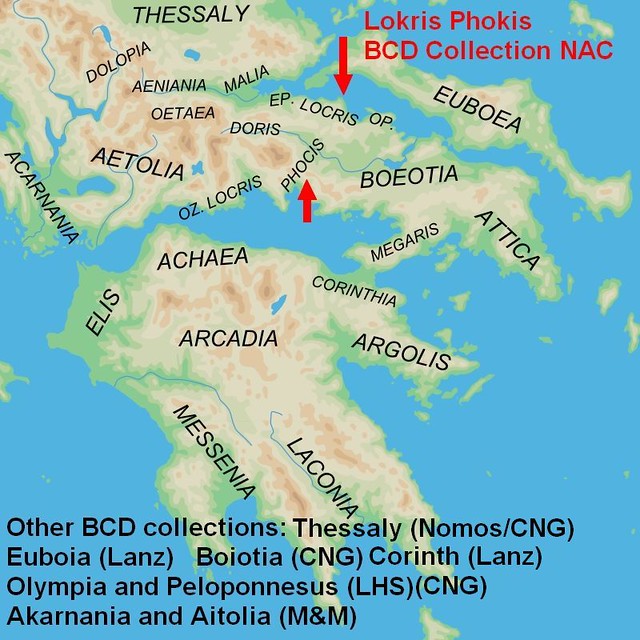
In October 2010, the Lokris - Phokis portion of the BCD collection was sold by Numismatica Ars Classica. Roberto Russo's foreword to the auction catalogue is a classic tribute to one coin collector, BCD, and to the art of coin collecting in general. You might think it has nothing to do with Roman Republican coinage or that comments would best reside in the Auction Catalogues page of this website rather than here with Collector Handbooks. But no, this foreword is aimed at new coin collectors whatever their area of interest. There's a message, about concentration, specialisation and doing things well, whatever your specialisation, thematic interest or or just general areas of collecting preference, even if your means are limited. Whether your collecting area is Republican Denarii, Ships on Roman Coinage, the silver coins of Julius Caesar, Aes Grave, or Republican struck bronzes, and whether you buy off eBay or NAC, collect with a purpose, get the books before the coin, and know where you are going. Read, think, apply.
Forward to the BCD Lokris Phokis Collection, Roberto Russo
When the series of sales of the BCD collection, or rather, collections began I was on the one hand fascinated by the uniqueness of the event and on the other deeply saddened because I had been erroneously told that the various collections would be sold by the companies who had most contributed to their creation. Unfortunately Numismatica Ars Classica was created too late to have been one of these firms. You can therefore imagine how surprised and delighted I was when BCD told me that he intended to entrust his collections of Lokris and Phokis to NAC. This auction follows Lanz's sale of Euboia, CNG's auction of Boiotia, LHS's auctions of Olympia and Peloponnesus and most recently M&M D's sale dedicated to Akarnania and Aitolia. Each of these sales captures the spirit or even the soul of this collector who represents the cultivated, refined, disinterested and unfortunately now bygone way of approaching coin collecting. Over the years I have always been astonished by the determination with which this timid and reserved man chased the objects of his dreams: the coins missing in this collection and the pieces that could possibly have improved the quality of those already present. In all these years I cannot recall him ever hesitating or being undecided over a coin that was really worth it. During my now long career I have been fortunate enough to have met only two people with such spirit and determination: BCD and Athos Moretti.
 BCD embarked upon his numismatic journey at a very young age and did so with unparalleled energy. First of all he
immediately understood the fundamental value of a library and therefore the importance of equipping oneself with the
necessary instruments for studying coins and forming a personal opinion. This is the first of the many lessons that BCD
taught and which should not be forgotten. We share this idea to such an extent that what we like to say to people who are
new to numismatics is that the first and essential step is to buy books and try to understand what they want to collect and
how they wish to do so. The reason is simple: for an honest and passionate numismatist there is nothing more satisfying than
discussing coins with a competent collector who knows what they're doing. Unfortunately today, this advice is not heeded
and many think that books are not necessary. This couldn't be further from the truth.
BCD embarked upon his numismatic journey at a very young age and did so with unparalleled energy. First of all he
immediately understood the fundamental value of a library and therefore the importance of equipping oneself with the
necessary instruments for studying coins and forming a personal opinion. This is the first of the many lessons that BCD
taught and which should not be forgotten. We share this idea to such an extent that what we like to say to people who are
new to numismatics is that the first and essential step is to buy books and try to understand what they want to collect and
how they wish to do so. The reason is simple: for an honest and passionate numismatist there is nothing more satisfying than
discussing coins with a competent collector who knows what they're doing. Unfortunately today, this advice is not heeded
and many think that books are not necessary. This couldn't be further from the truth.
However, whilst technical training and study are essential, their fruits are limited without natural talent and BCD has been blessed with a special gift which is reserved to very few people: the ability to "speak" with coins. As my mentor Giuseppe de Falco, one of the greatest numismatists I have ever met used to say, you are born a numismatist and you cannot become one. BCD was evidently born a numismatist and he has always been an authority on the geographical areas on which his collection is based for dealers and scholars alike rather than vica-versa. BCD was undoubtedly lucky to know a fantastic generation of numismatists from whom he obtained his method and inspiration, but it is only thanks to his great skill, determination and special gift, that he was able to develop an extraordinary ability and put together unparalleled collections.
Collecting is a magic word, which means having a simple, precise and impossible plan: to attempt to group together all existing coins of the relevant subject without making any distinctions either in terms of metal, denomination, period or value. Each coin becomes a piece of a colossal jigsaw which will only be complete once the last piece is in position. Therefore getting hold of a very expensive coin gives the same or perhaps even less joy than a cheap and seemingly insignificant coin whose importance is maybe only known by the collector.
The practical impossibility of this task is the biggest stimulus for the challenge. What BCD has achieved is before everyone's eyes and the coins speak for themselves. All of this is so distant from the current way of buying coins that it makes BCD look like he's come from another world and randomly landed among us. Today, all too often, small groups of coins are gathered with the main aim of making a lucrative investment. In this framework, the search for quality becomes an obsession and it matters little if there is no logical link between one specimen and the other or even a real plan.
The only excuse for today's collector is the limited time available to study and the inadequacy of most dealers to convey the right approach with this only seemingly easy discipline. Unfortunately today the coin trade is full of coin dealers (many of which are highly successful), but true numismatists are few and far between.
We musn't forget how BCD has always made himself available to scholars and students of numismatics. His collections and his incredible library have always been available to anyone who has ever wanted to consult them and BCD has always been generous with advice and information to anyone beginning to study the geographical areas included in his interests. This is yet another lesson which must not go to waste, especially in a dark age such as ours in which awareness of the crucial mission of private collectors has been lost as well as the recognition of the importance of collaboration between the commercial, collecting and academic worlds. Ignoring the fact that private collectors have always been the driving force behind numismatics means not knowing the history of this discipline. There are countless scientific publications written by collectors, without even mentioning the financial support that the commercial and collecting world has always provided for the publication of scientific works. Furthermore, we must remember that the constant donations of single coins and entire collections are the backbone of all the greatest public collections.
Ostracism towards private collecting and the free market is damaging for numismatics as a whole and the introduction of evermore restrictive laws will only make the necessary information for studying numismatics even less accessible.
Some people could think that BCD has decided to sell his collections because he has lost interest in coins or, worse still, to cash his investment. They couldn't be more wrong. The only reason why BCD decided to divide up his collection was to produce catalogues, or rather, Sylloge which could pass on at least a small part of his knowledge and which could be a contribition to numismatics. It was precisely with this spirit that NAC approached this publication: we wanted the catalogue of this collection to be as complete and exhaustive as possible which is why we didn't give any limitations to BCD either in terms of the number of images or the length of the text. For us, this auction is first and foremost a tribute to numismatics and a great numismatist.
With kind permission Roberto Russo, © Numismatica Ars Classica 2010
The collection which follows is, as Roberto Russo signals, annotated by BCD the collector. It is stuffed full of the details you would never find in a type catalogue, a couple of examples.
- Lot 61 Lokri Opuntii Stater Demeter/Ajax. The decoration on the edge of the shield on this die seems to be some kind of cross-stitching that also extends to the inside of the rim. It is therefore possible that the die cutter tried to depict the way by which the hide that covers the shield is stretched and tied around its edges.
- Lot 126 Lokri Opuntii Bronze Apollo/Cnemis in wreath.Imhoof-Blumer must have thought a lot about his - unique at the time - coin "à type parlant" because he published it twice within the space of three years. Once in Zeitschrift für Numismatik 1880 and again in Monnaies Grecques 1883, this time with a nice etching. According to the corpus the whereabouts of Imhoof-Blumer's coin is unkown today. Another one of these coins, its condition described as Tres Beau sold for CHF55 in M&M list 134 1954. No photograph or weight was given. This coin the third known of this type. Estimate 100 Francs. A great rarity that will probably be sold for a pittance. There are several such interesting and important coins that will not sell for much. Placing them in single coin lots and writing a special note about them is the least this writer could do to pay tribute to them and justify his choice.
Even if your coins are low cost examples off eBay, the least duty you owe them is to know your coins very very well just as BCD did, including his 100 Franc examples. Read up on your coins. Look for other more detailed examples on the internet. Understand everything about the type fully. And buy a good handbook before you own 10 coins and the standard reference on a series (Crawford in the case of our Roman Republic) before you own 50.
New Roman Republican coins published by the Goodman collection
I list here the main new coin varieties published in CNG43 to CNG47, with the observations and catalogue notes courtesy of Richard Schaefer. Richard is currently working on a large die studies project using auction catalogues as the source for images. For this work and his call for volunteers see the end of my page on Mints and Money . That just a single collection could encompass so many unrecorded types must be a message to all collectors and students to pay very careful attention to your coins, and examine any possible differences with the published types. In addition to the types listed below there is quite a long list of CNG43 to CNG47 coins listed as unique in Crawford, but whose presence in Goodman shows they are not unique. More minor variations published in Goodman, for example legend errors, small design features such as the number of spokes in a wheel, are not listed here. I guess if your interest extends to such variations then you probably already own a copy of Goodman.
- CNG45, 1126. Cf. Crawford 17. Quartuncia, Minerva head left with ROMANO legend / horsehead left ROMANO. An apparently common type but unpublished with head left and an obverse legend. Generally obverse legends only occur on the head right types. There are a few known head right legend types published by De Caro in 1988 but all have a star behind the head which this does not.
- CNG43, 1242. Cf. Crawford 28. Quadrigatus, unpublished type with a large obverse pellet in the angular truncation, and
unusually crude reverse lettering in frame. Compare the following, ordinary and fairly common, angular truncation with pellet type, which has a
much finer style than the CNG43 coin although superficially the same. It is the stylistic features that make the CNG43 coin noteworthy.
Lacking comprehensive die studies of the huge quadrigatus issues, style is all we have to go on for now.

- CNG45, 1160. Cf. Crawford 43/3. This is not the type illustrated on Crawford plate VIII, but it is the same as Kestner 279. See my thoughts on postsemlibral bronzes which mentions the type, an example of which is illustrated here.
- CNG45, 1156. Cf. Crawford 42/3. Grain ear sextans with the grain ear missing, never engraved on the die.
- CNG47, 1089. Cf. Crawford 89/4. Unpublished anonymous issue in the style of the club issue, see Crawford 89.
- Triton I, 915, unlisted series. SEX IVLI As of a series and type not listed by Crawford but similar in style to
Cn.Co Crawford 81. Crawford thought the one piece he had seen was altered. This, along with a further four
specimens now known, proves otherwise. The example
illustrated below, which is not the Goodman piece, is of Spanish origin as are at least two further specimens in the
Museo Arqueologico Nacional in Madrid. A further three specimens are known, the original Bern example condemned
by Crawford, the NAC7 example cited by Russo in Essays Hersh, and the Goodman example.
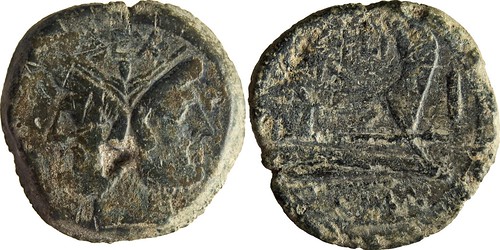
- CNG45, 1243, Cf. Crawford 97/4. Luceria triens, supposedly Cr.97, with a too high weight of 27.15 grams amounting to an 81 gram As. Refer again my thoughts on postsemlibral bronzes.
- CNG45, 1257, Cf. Crawford 100/1b. CA As type, but with CA clearly missing from both obverse and reverse.
- Triton I, 954, Cf. Crawford 106/10. This Goodman CA semuncia has the staff above the prow, listed as missing from
the supposedly unique specimen in Crawford. These very small coins can be exceptionally difficult to decipher specially
as they were often badly made. These semunciae are perhaps a little less rare than suspected
because worn specimens easily defy identification. The discussion that accompanies the following Crawford 56 semuncia is instructive as it is a
coin that I originally placed as Crawford 106/10, but by teasing out all available evidence I arrived in time at a different
conclusion:

- Triton I, 987, Cf. Crawford 147. CN.DO Triens. No Triens listed by Crawford.
- Triton I, 992, Cf. Crawford 151. S.FVRI As. No bronzes listed by Crawford although there is a similar piece in the BM, BMCRR827.
- Triton I, 1010, Cf. Crawford 177. PT Uncia. No Uncia listed by Crawford.
- Triton I, 1019, Cf. Crawford 181. caps of dioscuri Triens. No Triens listed by Crawford.
- Triton I, 1025, unlisted series. MVR As not listed in any standard catalogue although Bahrfeldt in NZ51, 1918 condemns a supposed worn piece as altered, and Crawford agrees with Bahrfeldt. However this piece is completely clear, so the type and series does exist.
- CNG45, 1451, Cf. Crawford 192. TA Sextans. No Sextans listed by Crawford.
- Triton I, 1047, Cf. Crawford 196/2. Star Semis with a six pointed rather than eight pointed star.
- CNG45, 1491, Cf. Crawford 203/3. C.MAIANI Semis. The obverse value mark S is retrograde.
- CNG45, 1477, Cf. Crawford 213/4. Mast and sail Quadrans. There is an image of a womans head on the prow stem, an unpublished feature for this series.
- Triton I, 1065, Cf. Crawford 213. Mast and sail Sextans. No Sextans listed by Crawford.
- CNG45, 1532, Cf. Crawford 231. C.RENI Triens. No Triens listed by Crawford.
- Triton I, 1082, Cf. Crawford 232/3. CN.GEL Triens with a laurel wreath on top of Minerva’s helmet. Richard Schaefer suggests that it may be a general feature not noted by Crawford as all other specimens of the type are very worn, including the one I illustrate which may or may not have a wreath at 1pm.
- CNG45, 1549 and 1550, Cf. Crawford 241. L.TREBANI Uncia. Two examples of the Uncia which is not listed by Crawford.
- CNG45, 1572, 1573 and 1574, Cf. Crawford 257. Semis, Triens and Quadrans from a previously unpublished anonymous series, similar in style to the issues of M. Vargunteius and Cn. Domitius Ahenobarbus. The fact that all three denominations exist for the issue prove it is not just a chance unfinished die for one of these moneyers. A further example of the Semis is in Triton I, 1111.
- Triton I, 1121, Crawford 280/1 Denarius overstruck on Crawford 281/1. Unlike the bronze issues of the Roman Republic, silver overstrikes are very rare. Crawford only lists seven examples known to him and only a few other specimens have come to light in recent years. Since the undertype Crawford 281 is supposedly later, this requires a redating of these coins.
- CNG43, 1615, Cf. Crawford 292/4a. P. NERVA Quadrans. The usual horse on the obverse appears to be an antelope with horns.
- Triton I, 1125, Crawford 292/3. The actual specimen cited by Crawford as unique.
- Triton I, 1142, Cf. Crawford 335/9. A.Albinus Denarius. A unique variety where the horseriders have cheek guards on their helmets.
- CNG43, 1643, Cf. Crawford 340/2e. L.Calpurnius Piso Frugi Quinarius. Unpublished type with a scorpion symbol on the reverse.
- CNG45, 1763, Crawford 478/1a. Sextus Pompey and Eppius As. This coin oddly disproves a previously accepted type, and
replaces it. The offstruck obverse is absolutely clear in its reading PIVS IMPE, whereas Crawford quotes PIVS IMP F.
The reading PIVS IMP F give in Crawford rests on Bahrfeldt’s statement in NZ 1909 that of the 38 examples
he found in European museums and collections, three showed PIVS IMP F. The Kiev example was probably
lost in WWII but the other two are in the d’Ailly collection in Paris. Richard Schaefer has examined all the
EPPIVS Asses in the d’Ailly collection but none show the F clearly. Thus, surprisingly the CNG45 specimen
is enough off centre to be the first published example with a complete lower obverse legend, clearly reading
PIVS IMPE. Sextus Pompey was telling the Roman world that he was not just the son of a famous man but had been
acclaimed Imperator himself, hence this coin is also historically important. Woytek, in Arma and Nummi, goes on to illustrate
this actual coin which he discusses in the text, a classic example of how the careful eye of an amateur student
can lead to an established numismatic fact published in the greatest books and journals.
The below illustrated example which
is actually Triton I, 1228, and rather better than the CNG45, is unfortunately perfectly centred and thus misses
the end of the legend which is only visible in the offstruck specimen.

- CNG47, 1209, Cf. Crawford 550/3a. Q.Oppius Pr. Dupondius, unpublished with a star behind the head of Venus, normally the star is before.
Handbooks & Priced Catalogues
Glossy Picture Books
If you do not get a sense of what this section is about then I am not going to explain, except to say that the books listed below generally lack any special academic credentials and often include non Republican era coins but still come highly recommended by me as great bed time reads. They can be rather expensive, a natural consequence of their astounding quality.
Roman Coins, J.P.C. Kent, Max and Albert Hirmer, 1978
This covers the entire Roman era, 200 stunning plates with 1400 highest quality coins magnified several times. 60 pages of well written main text, with a concise but precise description of the development of the coinage referenced to the plates, but there are additionally detailed descriptions of every illustrated coin at the back. This has possibly the highest quality productions values of any book reviewed on these pages and as such it actually represents very good value, and really is a must buy. The same book is available in German as Die Römische Münze by J.P.C Kent, B. Overbeck and A.U. Stylow with photos by Hirmer. As of writing, the English version was unavailable online, but the German could be easily found on amazon.de and other venues, and given the prime role of the plates can be considered nearly as useful. This is a companion volume to the famous Greek Coins by Kraay and Hirmer.
Le Monete Romane dell’eta Repubblicana, G. Belloni, 1960
At face value just an academic catalogue of the Milan collection, its superb production values and amazing plates make it stand out. 1300 illustrated Republican coins on 60 plates, many very rare, and including a full complement of bronzes sadly missing from most catalogues. Far better quality illustrations than the 1910 original Grueber or 1974 original Crawford, or than Haeberlin’s Cahn Hess sale, far better quality coins than Kestner Hannover. If this were only more widely available it would be a standard catalogue of the Roman Republican series, but only 1100 copies were minted (I have number 187) so it is very rare. For comments on the text see my museum catalogue listings . But, you are really buying this book for the pictures.
From the Coins Point of View, Bob Levy, 1993
Fabulous quality coins from Bob Levy’s collection, mostly Imperatorial with some early Empire, each with a short fictional story illustrating the coin’s life. This is inspiration for any collector considering writing a book about their collection.
Numismatic Fine Arts, Auction XXVII, December 1991
Also discussed on the auction catalogues page, its placement here is due to the fabulous quality of its Roman Republican silver in addition to ten plates of enlargements as well as in text illustrations. Many of the coins are both rare and FDC. Quite easily available.
Numismatic Fine Arts, Auction XXII, June 1989
As with the above NFA catalogue, discussed also in Auctions, here its place is earned by a complete run of Roman gold from Oath Scene to Romulus Augustus, with a full page of new numismatic research discussion per coin and the usual fabulous NFA production values. Thirty Republican amongst 170 Roman gold.
Principal Coins of the Romans. Vol. 1: The Republic, c.290-31 B.C, RAG Carson, 1978
Illustrates a representative selection of Republican coins in all metals from the British Museum collection. Quite short but very nice and one of a set of three books, including high and low empire, that generally command a decent price as a set. It includes discussion of the different eras of the coinage, as well as sporadic comments on individual types. Of course the coins are of the highest quality although the photos are merely good but it is still the most attractive small handbook of Republican coin types of those listed on this page. There are no concordances to Crawford or Sydenham so it cannot be considered as in any way useful, but who cares.
UBS 78, September 2008, Important Collection of Roman Gold and Silver Coins
This catalogue is important for its Imperatorial coins and as such is reviewed on the Auctions page. Here, however this could be considered a mini Kent Hirmer, a 250 page hardback review of the Roman coinage from the Imperatorial period onwards illustrated throughout with glossy colour photos, although being a sale catalogue it does not have much text. Everything is EF, there are many gold and rarities, and many are enlarged by 50% (as a benchmark, pictures in Kent Hirmer are generally twice a big again).
Julius Caesar and his Legacy, Numismatic Fine Arts, December 1991
Almost coincident with NFA XXVII, this a roll through Roman coinage illustrated by 150 superb coins with 100% enlargements throughout and explanatory text. References and concordances are relegated at the back. This unnumbered NFA sale, in Caesars Palace Las Vegas, was aimed squarely at rich and uninformed drunken gamblers. Because it was aimed at amateurs the text explains a lot about Roman history and coinage, much more a handbook than a catalogue. Not so many Republican since the auction starts with issues of Julius Caesar. Rare and very attractive.
100 Greatest Ancient Coins, Harlan J. Berk, 2008
Great production values, all coins enlarged in colour, with quite a few Republican placed amongst concurrent Greek since the book is strictly chronological from Ionia Electrums to the fall of Constantinople. Additional to the extensive coin descriptions is a primer on ancient coins and coin collecting so this also falls into the handbook category. In print. Buy the hardback version because it is a book you will wish to keep.
Greek and Roman coins from a distinguished American collection, Leu 52, May 1991
The best single all eras catalogue I know, much the better than any NFA catalogue or any single general handbook of Greek and Roman coins. All of Greek, all of Roman, 290 coins, superb quality, enlargements throughout, extensive numismatic notes against each coin. Only a few Republican, each of the greatest interest (Imperatorial gold etc.) but the purpose of this book is to understand the sweep of coinage in ancient times. Anyone who reads the notes will learn much of numismatics, helping place Republican coins in context. Kraay Hirmer and Kent Hirmer rolled into a single volume.
Essential Handbooks
RSC1 Roman Silver Coins, Volume 1 - Republic to Augustus. Seaby, London 1988
Essential – see the review in the Crawford Grueber Sear section.RCV1 Roman Coins and their Values, 5th edition Volume 1, David Sear, 2000
Essential – but with some reservations, see the review in the Crawford Grueber Sear section.
Important Handbooks
All the books listed in this section, except RCV 1988 which is an alternative to RCV1, have a role in your library in addition to the essential books listed above. Students of the era do need to read about the coinage, and not just peruse lists of coins, so amongst these I would probably place Andrew Burnett's book as your first purchase. It may give you a taste to read more than catalogues and if you acquire that taste then some of the books on my Mints and Money page or Coins and History page will likely spark more interest.
Die Munzen der Römischen Republik. R. Albert, 2003
I have almost the reverse feeling with Albert’s catalogue as with Sear RCV1. It’s a priced catalogue exactly as I would design it – the coins are presented in chronological order; silver, bronze, aes grave and gold together, almost all major silver types including important rarities are illustrated as well as a large and representative cross-section of the bronzes, the photographs and printing are very high quality, as is the quality of the illustrated coins, all taken from recent high-end auctions, and there are brief historical notes throughout. The early denarius coinages and early bronzes, as well as gold, often neglected in introductory handbooks, are particularly well presented. Nevertheless it is let down by several defects of accuracy. Several illustrations are misattributed, mostly from the early Republic involving easily confused coins, for example the Aes Grave issues with or without the sickle or club marks, or early Luceria issues confused with later ones. I believe this was generally due to mistakes in the original auction listings, but a handbook made for collectors, who may never own Crawford, demands accuracy. A further defect is that he applies the chronological order far too literally, for example separating those coins listed in Crawford as "211 to 209BC", from those listed as "211 to 208BC". This is not helpful as it disrupts the Crawford series numbering making coins difficult to find, but it also gives a false impression of numismatic accuracy as all these dates have a considerable uncertainty in each direction. Strangely, as with Sear RCV, I have an almost emotional need for both authors to do a better catalogue, because these handbooks are the first face any collector sees to the Roman Republic, and I want to attract collectors to my abiding interest, through books that are both well laid out and accurate. German language, but that does not detract from navigation as the pictures tell the story. In print and inexpensive. If you already own RCV1 I do still recommend you also buy Albert for a different way of seeing the coins of the Republic.
Fiorenzo Catalli; La Monetazione Romana Repubblicana; Instituto Poligrafico e Zecca Dello Stato – Libreria Dello Stato; Rome 2001
Good text, maps, color photos (generally blown up) of some coins and aes signatum and a catalogue of about 900 main coin types with 70 pages of plates. This is a perfectly acceptable shorter alternative to Crawford and in fact beats both RCV1 and Albert in terms of efficient layout - it brings all the coins from an issue into a single paragraph and cites key information from BMCRR and Crawford in that paragraph, though that includes dating, a subject on which really BMCRR should not be quoted. All the bronzes from an issue are listed under a single catalogue number, somewhat like in Sydenham. The abbreviated listings do not leave room for varieties, for example he lumps all the complex Luceria types under a single number that covers Crawford 97/3 through 97/28 inclusive. But it is clear and accurate within its own rule set, and the efficient layout leaves lots of room for discussion. A further bonus is quite a few original essays scattered throughout the text discussing magistrates, dating of issues, the origin of Roman coinage, various theories on the introduction of the denarius, the excavations at Cosa and at Morgantina, Social war coinage, an excavation at a mint site with illustratoins etc. Really this is an outstanding book and I see no reason why this might not be used as your sole catalogue, assuming you don't need pricing. The one significant downside as compared with RCV1 and Albert is that the lack of detailed listings of course has downsides if you are trying to positively ID a coin you are not familiar with. The plates are excellent quality and as with Albert are based on some key auctions in the late 1990s. If this was in English I might ordinarily use it instead of Crawford, so if you can read Italian well you should certainly buy it.
Roman Coins and their Values, 4th edition, David Sear, 1988
The last single-volume edition of RCV, recently reprinted, covering the entire Roman era including a representative selection from the Republic. Well balanced, a good book for the collector who has not yet decided to specialise in the Republican era.
Introductory Handbooks on Roman Coins - Wayne Sayles and Andrew Burnett
The Wayne Sayles series and the Seaby series of introductory handbooks are aimed at the same market so its best to discuss them together. Sayles: "The Roman World Politics and Propoganda" is of limited value to a Republican collector: it describes the denominations, the muse coins, and the civil war figures but the rest of the book is devoted to obscure emperors with hardly a mention of Sulla, Marius, the Scipios, the Hannabalic war, interesting reverse types etc. In common with all the books in the series, Sayles' photos and bibliographical notes are good. Burnett's "Coinage in the Roman World" (Seaby) concentrates heavily on either Republican coins or on topics that are relevant to the era such as circulation patterns, and also has good plates. There's a lot to learn in a short book, recommended. I admire Wayne Sayles’ series of books but as regards the Roman Republic Andrew Burnett has the better introductory book.
Introductory Handbooks on Provincial Coins - Wayne Sayles and Kevin Butcher
Wayne Sayles "Roman Provincial Coins" wins over Kevin Butchers book of the same name (Seaby). The Sayles book takes a geographic tour around the empire, giving an excellent perspective on issues of trade and conquest. A Republican collector will learn quite a lot by reading each section until it turns imperial - its a good prelude for a dip into RPC. Good photos. Butcher's book has a briefer geographical tour mainly illustrated by line drawings, as well as sections on coin use and interpretation for which RPC now provides a better overview. Sayles clearly wins this round.
Introductory Handbooks on Collecting - Wayne Sayles and J.P. Andrew
Wayne Sayles "Ancient Coin Collecting" contans lots of tips on how to buy and sell coins, how to care for coins, how to build a collection, coins and the internet, interspersed with short sections on specific series to whet the appetite. A very interesting book, even for an experienced collector. Seaby published "Coins and Investment, a Consumers Guide" by J.P. Andrew in 1986. It discusses a market centred solely around major dealers that is barely relevent today. Not recommended.
Classical Deception: Counterfeits, Forgeries and Reproductions of Ancient Coins, Wayne Sayles
Publications on forgeries are usually aimed at the numismatic profession (such as the International Bureau for Supression of Counterfeit Coins IBSCC bulletins) but this is aimed squarely at the collector who wishes to protect themselves from buying forgeries. A very useful compendium of photos and review of the work of different forgers, but would have been even better if it included some generic tips on detecting forgeries illustrated with close-up photos - such a book is still called for.
Not Useful
Monnaies de la Republique Romaine, R. Rolland, Paris 1929
Le Monete D'Oro E D'Argento Della Repubblica Romana. C. Varesi, A. Castellotti
Both these are poor quality priced handbooks with line drawings, there are much better alternatives available and not the slightest reason to buy either.
A Guide to the Denarii of the Roman Republic to Augustus, Molina, José Fernández; Manuel Fernández Carrera and Xavier Calico Estivill, 2002
I guess there are degrees of inaccuracy, but the invisible line is passed when an author deliberately makes up information to compensate for lack of knowledge or research. This book supposedly illustrates 1235 denarii of the Republic including many varieties, 238 denarii of Imperatorial times and 342 denarii associated with Octavian/Augustus. In reality many of the variety photographs are fabricated using imaging software when the authors could not find a real specimen, and many of the fabricated images, which are not identified in the book, are quite wrong – concoctions of non-existent coins. Of course once you realise this, you no longer know which photos to trust. Dangerous.
All content copyright © 2004-2011 Andrew McCabe unless otherwise noted. If you've any questions or comments please contact me on the Yahoo Group RROME: http://groups.yahoo.com/group/RROME.
Alternately you can leave comments against any coin picture, just click on the picture and write in the comment box.
See my rarity estimates for Roman Republican Bronzes: Roman Republic Bronze Rarities..